The small door that sets coffee’s benchmark price
A record harvest is coming. The price everyone watches rests on a much smaller pile of tested coffee. Here is why, from the very beginning.
Tap or press the right arrow to begin
The world is about to grow more coffee than ever.
Coffee is counted in bags. One bag holds 60 kilograms of green coffee, which is coffee before it is roasted.
Source: USDA Foreign Agricultural Service, Coffee: World Markets and Trade, 2 July 2026. Forecast.


Brazil alone grows nearly four of every ten bags.
Brazil is forecast to grow 71.9 million bags. That is about 38% of the world’s coffee. Vietnam is next, with 32.5 million.
Most countries grow a bit more this year. Indonesia and India grow a bit less.
Source: USDA FAS, 2 July 2026. Millions of 60 kg bags.
More coffee, lower price.
When there is more of something, each piece is usually worth less. Coffee follows that rule.
The International Coffee Organization keeps a price index for coffee. In March 2025 it stood at 347.85 US cents per pound. In May 2026 it averaged 256.05. That is about 26% lower.
Source: ICO Coffee Market Report, Feb 2026; ICO daily prices, May 2026; Oct 2026. Dotted line: months not shown here.
To agree on a price, people point at one number.
Coffee news most often quotes one price: the “C” price. It comes from a market in New York run by the exchange ICE.
The key point: on the last day, the promise can end with real coffee changing hands.
Only tested coffee can keep that promise.
If a promise can end with real coffee, the exchange must know the coffee is good enough. So it tests it. A coffee that passes is called certified.
This is not organic or fair trade. It is a pass-or-fail check run by the exchange, and the coffee then waits in a licensed warehouse.
Source: ICE rulebook, Rule 8.04 and Appendix II; SCA explainer.
The test asks three plain questions.
- Does it taste clean?No stale, aged or unwashed flavours. Tasters try at least six cups.
- Are the beans big enough?At least half of the sample must be size 15 or larger.
- Are there few flaws?Black, sour or broken beans are counted. Only a small number is allowed.
Source: ICE rulebook, Rule 8.04, Appendix II.
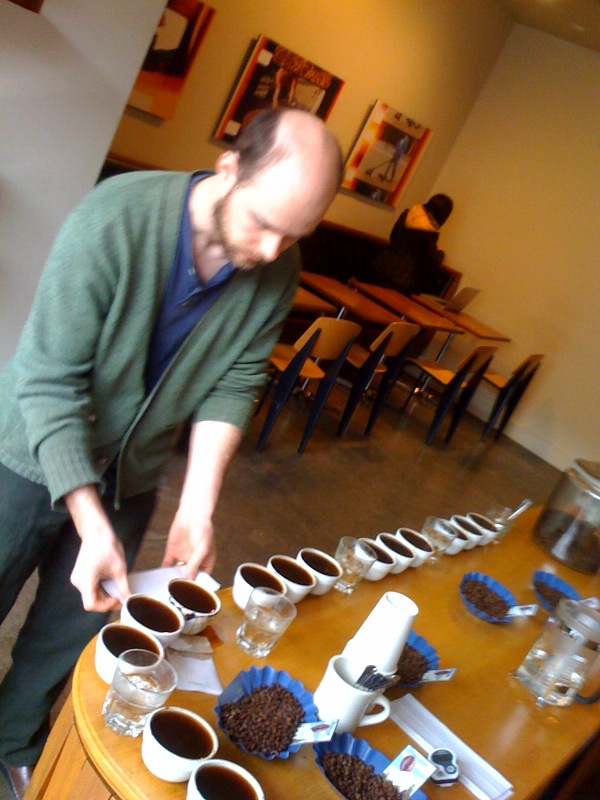

Passing the test is not the same as scoring high.
Two different checks answer two different questions. Mixing them up is easy, so keep them apart.
A pass-or-fail check so that coffee can be delivered on the exchange.
Trained tasters rate a coffee on a scale, so an especially good lot can earn more.
Sources: ICE rulebook, Chapter 8; Specialty Coffee Association cupping practice. Specialty coffee often sells on its own terms, not only off the benchmark.
Now count how much coffee has passed.
In November 2025 the certified pile in New York was 0.44 million bags. A year’s world crop is about 179 million.
Read this as a sense of scale: it compares a pile in storage with a year of harvest.
Source: ICO, Feb 2026 (stock); USDA (178.8 million bags, 2025/26). 0.44 / 178.8 = 0.25%.
And that small pile got smaller.
New York’s certified arabica stock stood at 0.93 million bags in May 2025. By November 2025 it was 0.44 million, about half.
It rose only a little afterwards: 0.52 million in February 2026.
Source: ICO Coffee Market Report, Feb 2026, Table 5. Millions of 60 kg bags, end of month.
Rain can spoil coffee after it has grown.
After picking, coffee is dried, often in the sun. If it stays wet, mould can grow. Some moulds make poisons called mycotoxins.
On 30 September 2026, Brazil’s largest coffee cooperative, Cooxupé, told its roughly 20,000 farmers it will refuse coffee damaged by moisture.
A wet harvest does not change how much coffee grows. It changes how much of it is good enough.
Source: Forbes Brasil, 30 Sep 2026; Reuters via Business Recorder, 1 Oct 2026. Animation is an illustration.
Colombia grew 15% less coffee.
Colombia’s coffee federation reported on 9 October 2026 that the coffee year ending in September made 12.65 million bags. The year before it was 14.87 million.
That is 2.2 million fewer bags. Colombian coffee is one of the kinds that can be delivered on the exchange.
Source: Portafolio / FNC, 9 Oct 2026; Forbes Colombia. Eligibility: ICE Rule 8.03.
Put the dates in order and the pattern shows.
Big supply on one side. Gates on the other: quality gates now, paperwork gates soon.
From 30 December 2026 the EU’s deforestation rule makes large and medium companies check, and declare, that the coffee they bring in did not cause deforestation. The smallest follow on 30 June 2027.
Dots are evenly spaced, not drawn to time scale.
Sources: Safras, USDA, Forbes Brasil, Portafolio, European Commission.
A big harvest does not widen a small door.
The world can grow a record crop. But the price everyone quotes leans on the small part of it that passes one test, and the quality of the crop decides that part, not its size.
Our reading of the evidence on the previous slides.
Quality is made long before the door.
Mould and moisture start at drying and storage, not in the cup. Four ways to use this:
These are suggestions drawn from the evidence, not rules from the exchange.
Where every number comes from
- Crop forecasts — USDA FAS, Coffee: World Markets and Trade, 2 Jul 2026
- Prices and certified stocks — ICO Coffee Market Report, Feb 2026; ICO prices, May 2026; ICO prices, Oct 2026
- The test — ICE Futures U.S. Coffee “C” rulebook, Ch. 8; SCA explainer
- Colombia — Portafolio; Forbes Colombia, 9 Oct 2026
- Brazil rain rule — Forbes Brasil; Business Recorder
- EU rule — European Commission; Hogan Lovells
- US tariff change — Safras, 24 Nov 2025
- Photos — Costa Rica patio: Ronchy, Commons, public domain. Brazil farmer: USAID, Commons, public domain. Cupping: David Burn, Commons, CC BY-SA 2.0.
- Method — Every figure was checked against a primary source or two independent sources. “1 in 400” is our calculation: 0.44 ÷ 178.8 million. Charts and the rain animation are illustrations built from these figures.
- Left out because we could not confirm it — how much coffee Brazil has rejected, what share of a cup’s price reaches the farmer, and how much a cupping point adds to price.

vizmaya desk · 13 October 2026